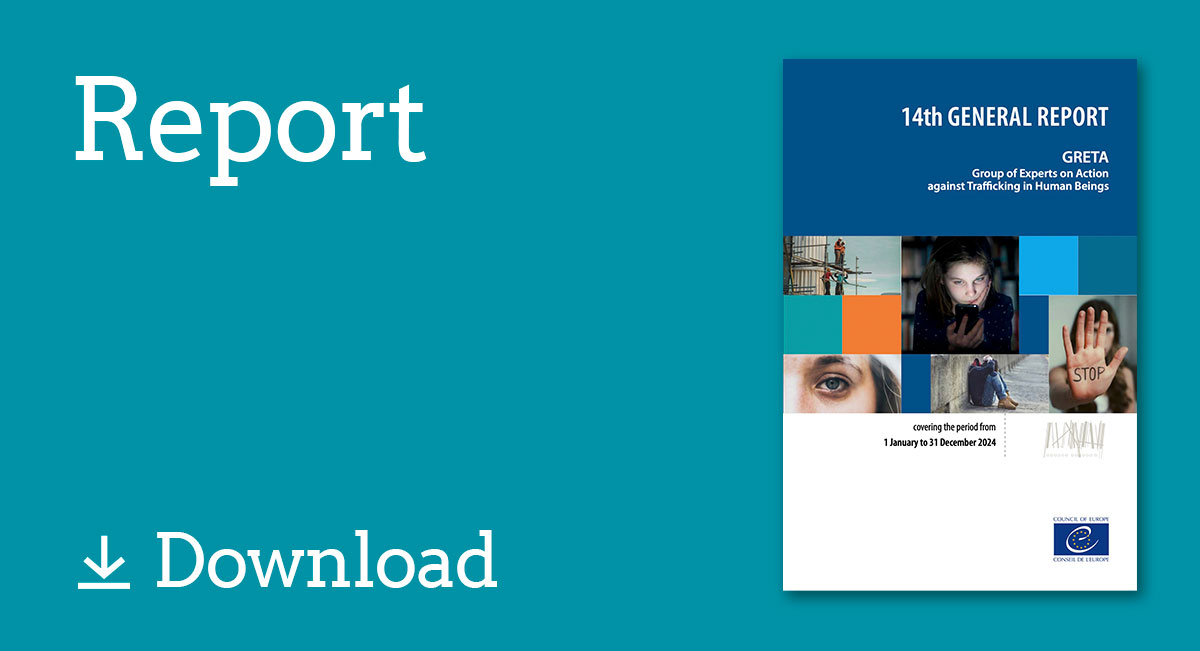


It is my pleasure and privilege to introduce the 14th General Report on the activities of the Group of Experts on Action against Trafficking in Human Beings (GRETA), covering the period from 1 January to 31 December 2024.
The report highlights the work carried out by our group during the year, including country evaluation visits to 13 State Parties, the publication of reports concerning another 12 Parties, and the organisation of round-table meetings in yet another 10 Parties as a follow-up to previous GRETA reports. This intense activity demon- strates GRETA’s resolve to maintain an ongoing dialogue with State Parties, which is a crucial element of the monitoring of the Convention.
I am particularly satisfied that GRETA managed to carry out the third evaluation visit to Ukraine, which had been postponed since 2022 due to Russia’s full-scale invasion. This was not a GRETA visit like any other. Despite the limitations imposed by security concerns and the complicated travel arrangements, GRETA travelled to Ukraine in order to collect information on the ground and document the efforts that the authorities and civil society are making to continue combating human traffick- ing despite the immense challenges created by the war. GRETA is grateful to the Ukrainian authorities for enabling the organisation of the visit in the context of an ongoing war. We hope that GRETA’s report will provide impetus for the Council of Europe to further support Ukraine in increasing its capacity to prevent and combat human trafficking and related violations of human rights.
This year’s general report includes a chapter which summarises the results of 15 years of monitoring of the implementation of the Convention by GRETA, outlines the progress made, and pinpoints remaining challenges. A number of key milestones have been reached over the years. The number of States Parties to the Council of Europe Anti-Trafficking Convention grew from 18 at the time of the first Committee of the Parties’ meeting when the first GRETA members were elected, to 48 at present. GRETA has carried out three rounds of evaluation of the Convention and published some 140 country evaluation reports which trace the evolution of national efforts to combat human trafficking. The monitoring work undertaken by GRETA has triggered many positive changes, which result in greater protection of the rights of victims of human trafficking, ultimately preventing violations of the European Convention of Human Rights. The publication “Practical Impact of GRETA’s Work in Improving the Implementation of the Convention on Action against Trafficking in Human Beings”, launched on the occasion of GRETA’s 15th anniversary, is an illustration of the results which systematic, rigorous and independent international monitoring can produce.
These impressive figures and results are the outcome of great collective efforts. I would like to give credit to all the people behind this endeavour – the former and current GRETA members, with their wide-ranging expertise, and the hard-working Secretariat that keeps the monitoring mechanism running. We are also very grateful for the support that we have received from successive Secretary Generals and Deputy Secretary Generals of the Organisation, the Committee of Ministers, the Committee of the Parties to the Convention, as well as the Parliamentary Assembly.
Consistency of approach and coherent standards are profoundly important, which is why GRETA has strived to develop standards for implementing the Convention’s provisions through the interpretation of their substantive content and providing examples of good practice to be followed. An important highlight of 2024 was the adoption of a new Guidance Note, on the recovery and reflection period, provided for in Article 13 of the Convention. GRETA trusts that by clarifying the obligation to grant a recovery and reflection period to victims of trafficking, the Guidance Note will strengthen its implementation of this key provision of the Convention, which is an essential step in protecting and assisting victims of trafficking.
In 2024, GRETA made good progress on the fourth evaluation round of the Convention, which was launched in June 2023. It finalised the evaluations of three Parties under this round (Austria, Cyprus and the Slovak Republic), carried out visits to 10 other Parties, and sent the questionnaire for the fourth round to six more Parties. The the- matic focus of this new round of evaluation of the Convention is on vulnerabilities to trafficking in human beings and measures taken by States Parties to prevent and detect them, and to punish the perpetrators. The relevance of this focus has been recently highlighted by the judgment of the European Court of Human Rights in the case of B.B. v. Slovakia (application No. 48587/21), which showed how intersecting factors such as gender, belonging to a minority group and socio-economic status, interact and increase vulnerability to human trafficking.
In its monitoring work, GRETA relies on a variety of information sources, not only from public officials, but also from civil society and independent national human rights bodies. GRETA is grateful for the contributions made by NGOs to its monitoring work and is committed to continuing the existing co-operation with civil society. GRETA is concerned by attempts to exclude civil society from anti-trafficking efforts in some States, and will continue monitoring how governments work with NGOs on combating human trafficking and whether their voices – as well as the voices of people with lived experiences – are taken into account. GRETA is convinced that only through co-operation and strategic partnerships with civil society, as provided for in Article 35 of the Convention, can the purposes of the Convention be achieved.
After 15 years of monitoring, GRETA observes that some recommendations that it has made repeatedly to States Parties have not been implemented or have been only partially implemented. This may be due to different factors, including lack of resources, prioritisation or political will. In this respect, it is important that the Committee of the Parties, as the political pillar of the monitoring mechanism of the Convention, encourages the implementation of GRETA’s conclusions.
The appointment of independent national rapporteurs on trafficking in human beings and/or the involvement of national human rights institutions is also essential for strengthening the implementation of the Convention. Further, local and regional authorities have a key role to play in the fight against trafficking in human beings.
The fight against human trafficking cuts across many of the areas of work of the Council of Europe and is a truly transversal issue. With a view to strengthening the impact of its work, GRETA has continued to build synergies with other Council of Europe bodies, including the Parliamentary Assembly, the Congress of Local and Regional Authorities, the Lanzarote Committee and the Consultation Group on the Children of Ukraine.
As a result of the elections of GRETA members held by the Committee of the Parties on 29 November 2024, four GRETA members were re-elected for a second term of office and four new members were elected. I was amongst the four GRETA members whose mandates expired at the end of 2024. I would like to wish the new panel of experts perseverance and success in continuing the important mission entrusted to GRETA by the Convention.
GRETA’s independent voice has helped change laws and lives – but human traf- ficking is far from defeated. As traffickers adapt, so must we. In the face of growing and evolving threats, we need stronger political commitment and concrete action more than ever.
Helga Gayer
President of GRETA until the end of 2024